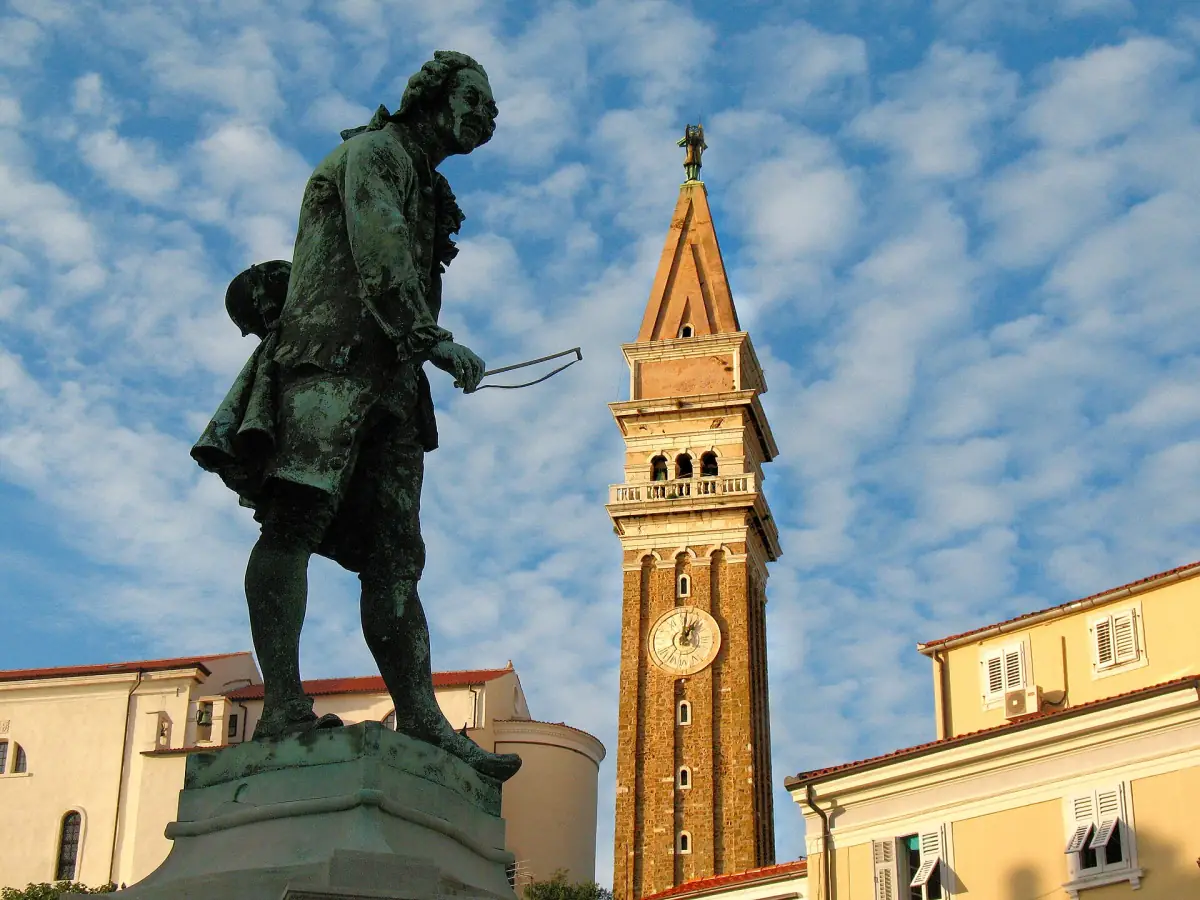
Reading Piran history in the old town
Piran history is easiest to follow through the places that still shape a visit: Tartini Square, the fortifications and the Church of St. George. These landmarks tell different parts of the story. The square records a change from water to public space, the walls reflect successive building phases, and the church complex brings together architecture and religious collections above the old town.
Begin with that relationship between the places rather than trying to fit every building into a complete political timeline. Piran is a coastal town in Slovenian Istria, with medieval fortifications around its peninsula. Its streets and buildings provide the setting for a history-focused walk. For the practical choice of sights to enter, use the separate Piran sightseeing guide; this page concentrates on what the places reveal about the town's past.

Tartini Square: from inner harbour to civic space
The central square occupies the former inner harbour known as Mandrač, which was filled in during 1894. That transformation is a useful way to read the space today: a town associated with the sea made a public square where an inner harbour had stood. Look at the relationship between the open space and its surrounding historic buildings, including the Gothic Benečanka.
The square takes its name from Giuseppe Tartini, the violinist and composer born in Piran in 1692. His bronze monument, created by Antonio dal Zotto, has stood here since 1896. Keep those events distinct: the harbour conversion and the monument belong to different moments. Together they explain both the physical form of the square and the name through which visitors encounter it today.
Our pick: History
This trip from Ljubljana includes sightseeing in Piran.
Hand-picked tours, booked through GetYourGuide. Prices are indicative starting prices in euros (as of October 2026). Tap a tour for live availability and the current price in your currency.


Images – Lipica and Piran from Ljubljana: Crop of a photo by Clemens Stockner · CC BY-SA 4.0

See Piran on a guided day trip
The outing from central Ljubljana combines Lipica with a Piran sightseeing tour, driver-guide and air-conditioned transport; attraction entry fees are extra.
The city walls as a sequence of building phases
The fortifications developed in several phases. The third wall circuit was built from 1470 to 1533, a period that helps place this part of Piran's built heritage before the present Baroque church. Think of the walls as a record of a changing town rather than a single structure produced at one moment.
For a history-focused visit, compare the fortified setting with the more open civic space of Tartini Square. Each draws attention to a different function of the town. A guided Piran walking tour can connect the lanes and historic buildings into a visit, while the sightseeing guide handles entry choices and the physical demands of the wall access.
St. George, the campanile and collections
The present Baroque Church of St. George was built after 1595 on the site of a Gothic predecessor and was completed and consecrated in 1637. The campanile was built from 1600 to 1615, taking inspiration from the bell tower of St. Mark's. These overlapping dates show the church and tower as related building projects with their own construction periods.
The complex includes the church, bell tower, baptistery and parish museum. The museum brings together a treasury, lapidarium and archaeological basement, giving the site more layers than the exterior alone suggests. The tower exterior was restored in 2025. This recent work is another part of the building's history, distinct from the early construction dates. Make interior visits around the access arrangements for your day.
A Piran day trip with Lipica
The guided day trip starts from selected central pickup points in Ljubljana and lasts 9.5 hours. It includes pickup and drop-off at those points, air-conditioned transport, a driver-guide and a Piran sightseeing tour. Lipica admission, Piran city-wall admission, food and drinks are extra. Choose it for an organised journey that brings the coastal town into a wider day.
Lipica is a separate stop within that excursion. For regional context beyond Piran, see Škocjan Caves and the Karst. Keep the Piran part of the day focused on the square, lanes and historic setting rather than expecting a specialist history seminar. To compare other journeys from the capital, use day trips to Piran from Ljubljana.
Art alongside the historic buildings
Piran's cultural visit can also include the city gallery. This adds an art stop to a walk otherwise centred on the square, fortifications and church architecture. Decide whether the gallery belongs in your programme before adding another excursion, so the old town receives the attention you want to give it.
A useful approach is to follow one theme closely: the square's transformation, the sequence of wall building or the church complex. The surviving landmarks make each theme tangible. You can return to the others on another walk rather than reducing every site to a date and a photograph.
Questions about your visit
What occupied the site of Tartini Square?
It was formerly the inner harbour called Mandrač. The harbour was filled in during 1894, and the Tartini monument followed in 1896.
Who was Giuseppe Tartini?
He was a violinist and composer born in Piran in 1692. The central square is named after him and contains his bronze monument by Antonio dal Zotto.
Are church and wall tickets included in the day trip?
The excursion includes transport, a driver-guide and a Piran sightseeing tour. Lipica and Piran city-wall entry fees are extra; plan any individual interior visits separately.